

Rideshare Accident Lawyer
After a crash involving an Uber or Lyft car, the first question is not only who caused it, but what the driver’s app was doing at that moment. State law sets different insurance amounts for when the driver is offline, logged in and waiting for a request, or carrying a passenger.
This page explains those rules in the states where Sweet Lawyers takes cases. Whether you were a passenger, the rideshare driver, or someone hit by a rideshare car, call (800) 674-7854. The first conversation is free, and you pay no fee unless we win.

Rideshare Insurance Depends on What the App Was Doing
State laws call Uber and Lyft “transportation network companies.” Their insurance rules split a driver’s time into periods:
- App off: the rideshare insurance rules below do not apply; the driver’s own auto policy is the main coverage.
- App on, waiting for a ride request: lower minimum limits apply.
- Ride accepted, on the way, or passenger on board: the highest limits apply, often $1 million.
Here are the minimums set by law in four of our states:
| State | Logged in, waiting for a request | Ride accepted or passenger in the car | Law |
|---|---|---|---|
| California | $50,000 per person / $100,000 per incident for injury or death, $30,000 property damage, plus $200,000 excess coverage | $1,000,000 for death, injury and property damage; plus uninsured/underinsured motorist coverage of $60,000 per person / $300,000 per incident while a passenger is in the car | Public Utilities Code § 5433 |
| Arizona | $25,000 per person / $50,000 per accident for injury or death, $20,000 property damage | At least $250,000 per incident, or $1,000,000 per incident when a passenger is in the vehicle; plus uninsured motorist coverage | A.R.S. § 28-4038 |
| Washington | $50,000 per person / $100,000 per accident for injury, $30,000 property damage | $1,000,000 combined limit for death, injury and property damage during a prearranged ride | RCW 46.72B.180 |
| Texas | $50,000 per person / $100,000 per incident for injury or death, $25,000 property damage | $1,000,000 total for death, injury and property damage per incident during a prearranged ride | Insurance Code §§ 1954.052 and 1954.053 |
For a crash in Colorado, New Mexico or Missouri, call us and we will explain the coverage rules there. In every state, the app’s trip records are key evidence, because they show which period the driver was in when the crash happened. Ask for them early.
Why Work with a Rideshare Accident Lawyer
Pinning down the coverage period
The insurer’s first move is often to argue the driver was in a lower-coverage period. A lawyer requests the trip data and the driver’s app status at the moment of the crash.
Finding every policy
A single crash can involve the rideshare company’s policy, the driver’s personal policy, the other driver’s policy, and your own uninsured or underinsured motorist coverage.
Handling the companies
Uber and Lyft treat drivers as independent contractors and often deny responsibility for the driver’s conduct. Your lawyer deals with their claims teams and insurers so you are not pressured into a low settlement.
Going to court if needed
If a fair offer does not come, your lawyer files suit before the deadline and takes the case to trial if necessary.
Common Causes of Rideshare Accidents
- Distraction: drivers use their phones for navigation, accepting requests and messaging riders.
- Fatigue: long shifts to earn more can slow reaction time.
- Speeding and rushed pickups: drivers hurrying to the next fare.
- Unsafe stops: sudden pull-overs and double-parking to pick up or drop off riders.
- Poor vehicle maintenance: worn brakes or tires on a car driven many miles.
- Other drivers: a third party may cause the crash, which brings in that driver’s insurance as well.
Common injuries
- Whiplash and other soft tissue injuries
- Broken bones
- Head and traumatic brain injuries (see our brain injuries lawyer page)
- Spinal cord injuries (see our spinal cord injury attorney page)
- Cuts and lacerations
- Emotional distress and PTSD
What to Do After a Rideshare Accident
- Get medical care and keep every record.
- Call the police so an official report is made.
- Take screenshots of the trip in your app (driver name, car, time, route) before anything changes.
- Photograph the vehicles, the scene and your injuries, and get witness names.
- Report the crash in the app, but do not give a recorded statement to any insurer before getting legal advice.
- Talk to a lawyer about the deadline in your state.
Passenger Cases From Our Results Page
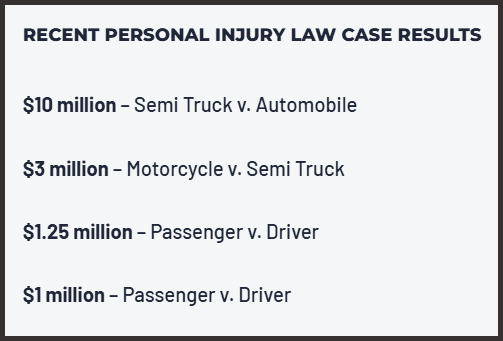
Our results page lists recent passenger results of $1.25 million and $1 million in Passenger v. Driver cases. In another case, a client riding as a passenger in a family member’s car was severely injured after both had left a bar; other firms had passed on the case, but we placed fault on the bar for serving alcohol to a minor and settled for $1,000,000. These were not rideshare cases, but they show how we look past the obvious defendant to every party and policy that can pay.
FAQs About Rideshare Accident Claims
Rideshare companies classify drivers as independent contractors and often deny responsibility for a driver’s negligence. Even so, the insurance that state law requires them to carry, or make sure drivers carry, can pay for your injuries depending on what the app was doing at the time of the crash.
Medical bills, lost wages, pain and suffering, property damage and emotional distress.
2 years in California (Code of Civil Procedure § 335.1), Arizona (A.R.S. § 12-542) and Texas (Civil Practice and Remedies Code § 16.003); 3 years in Washington (RCW 4.16.080) and New Mexico (NMSA § 37-1-8); 3 years in Colorado for a motor vehicle crash (C.R.S. § 13-80-101(1)(n)); and 5 years in Missouri (RSMo § 516.120). Act quickly, because trip data and video are easier to get early.
In California, the rideshare company must provide uninsured and underinsured motorist coverage of $60,000 per person and $300,000 per incident from the moment a passenger enters the car until the passenger exits (Public Utilities Code § 5433(b)(2)). Arizona also requires uninsured motorist coverage during a ride (A.R.S. § 28-4038). Your own auto policy may add more.
If another driver caused the crash, you can claim against that driver’s insurance. Your own coverage and the rideshare company’s coverage depend on your app status at the time. Call us to sort out which policies apply.
If you were hurt in an Uber or Lyft crash in any of our seven states, call (800) 674-7854 or use our contact page.